

AI999X Scientific Models
Collection
All 31 AI999X scientific models: offline solvers with exact, step-by-step answers across 7 fields (2,696 capabilities). • 31 items • Updated
Astronomy covers celestial mechanics and orbits, stellar properties, blackbody radiation, magnitudes and distances, cosmology basics, the Sun and space environment and plasma parameters: 67 calculations in 13 topics, each with its formula, its steps and its units, and a plain reason instead of a number when an input is missing or out of range. One compiled engine, four ways to use it: the desktop app, the command line, the browser and Python. Everything runs on your own computer, offline.
| Desktop app (Windows, Linux) | Windows · Linux |
Command line astronomy (Windows, Linux) |
Windows · Linux |
| Browser (any device) | Try it on the model page |
| Python 3.10+ | pip install astronomy-ai999x: on Windows and Linux (x86-64) pip installs the same compiled engine; on other systems (macOS, ARM) it installs a pure-Python build that gives the same answers |
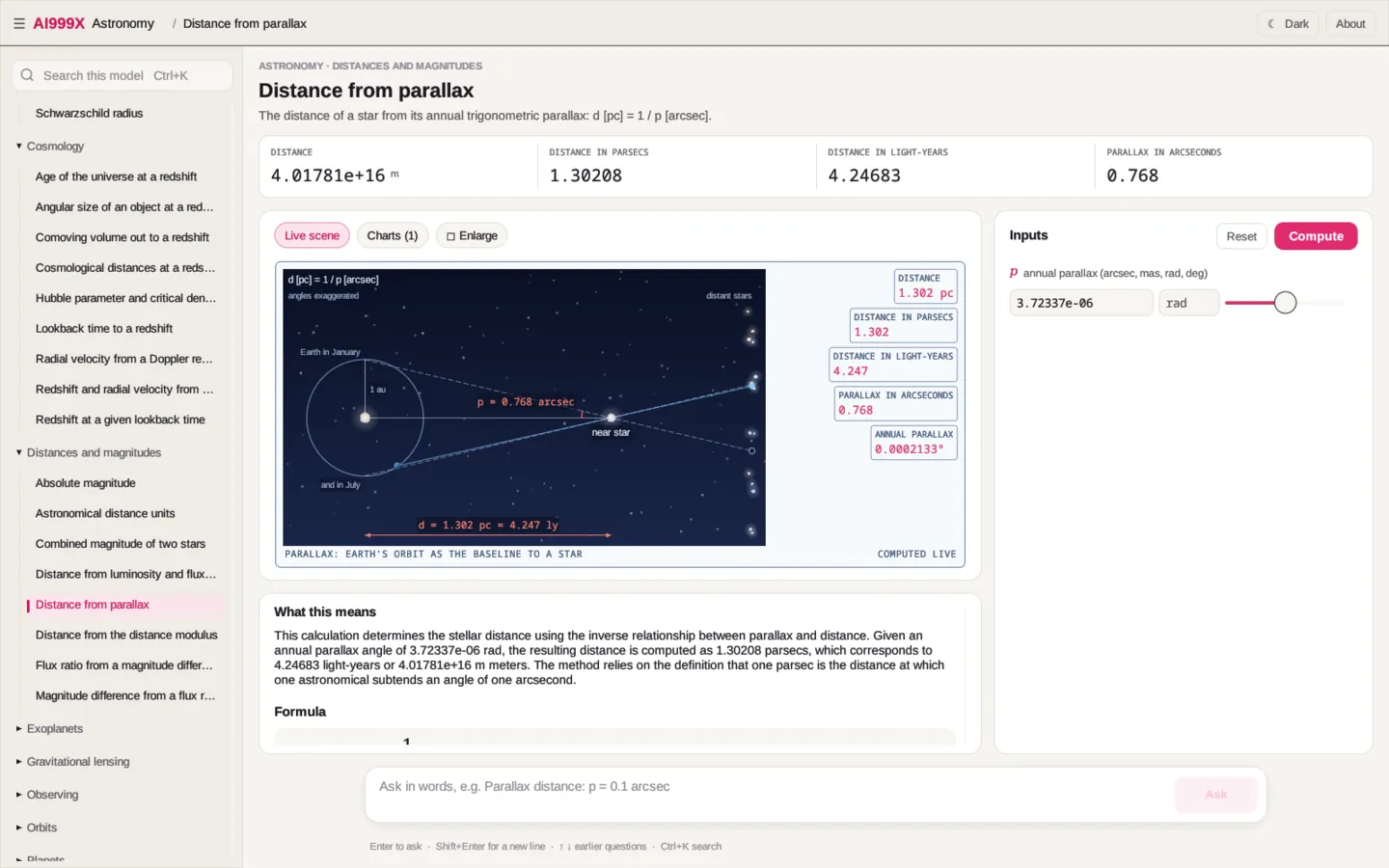
From the Astronomy desktop app: every scene and chart is drawn from the computed answer.
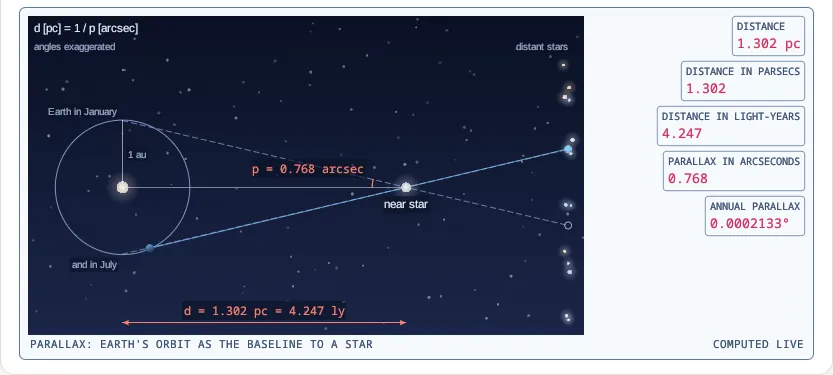 Distance from parallax |
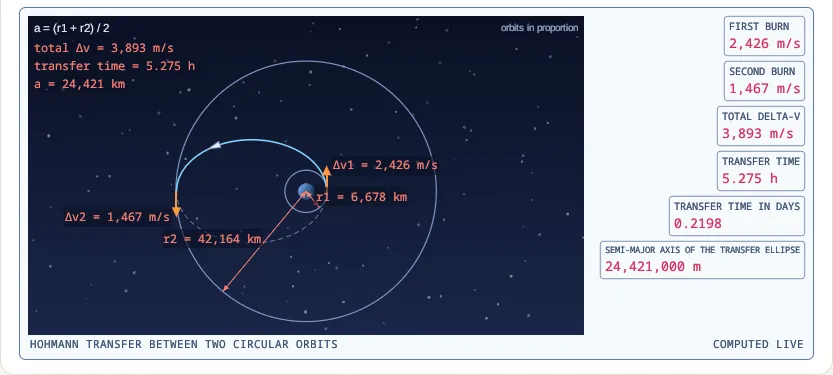 Hohmann transfer between circular orbits |
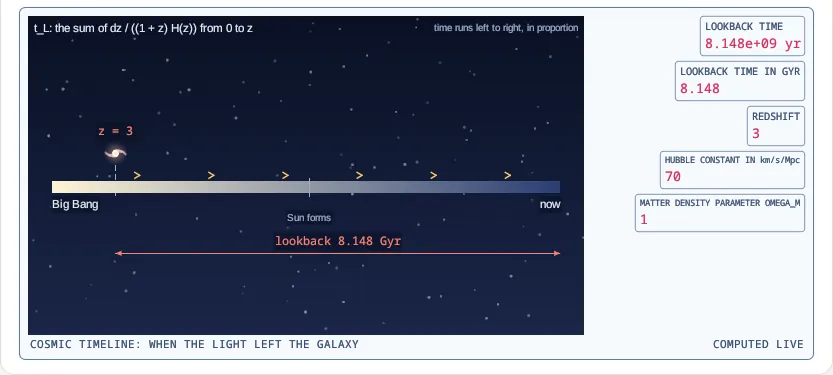 Lookback time to a redshift |
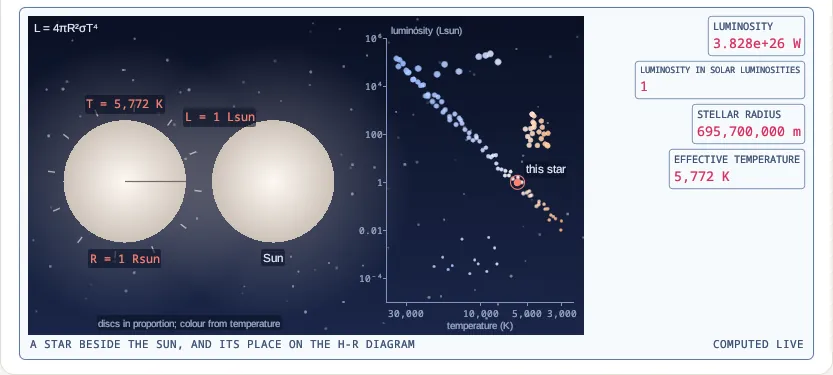 Luminosity of a star (Stefan-Boltzmann) |
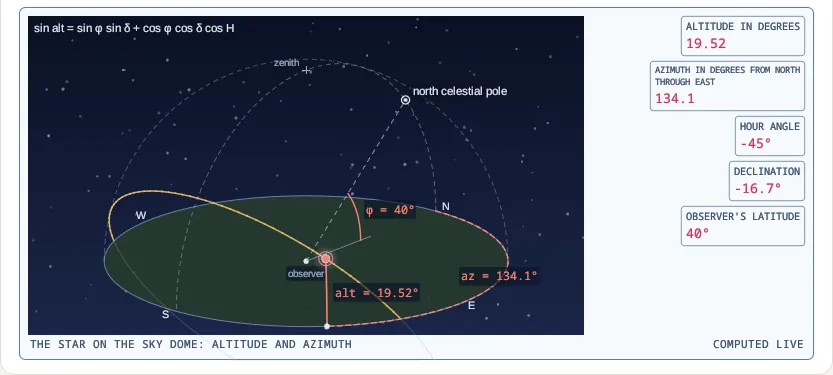 Altitude and azimuth from hour angle and declination |
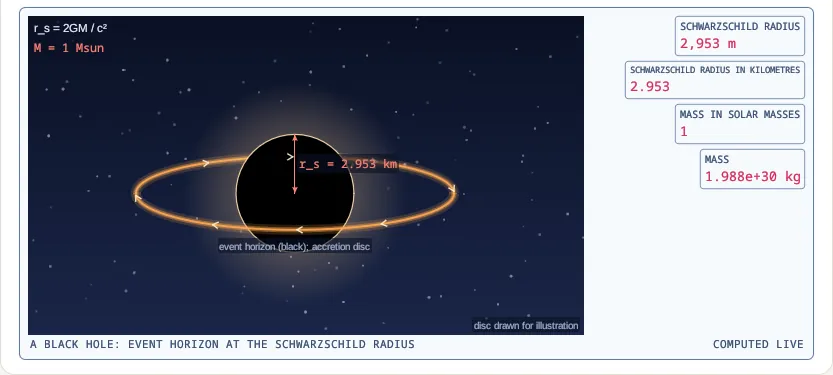 Schwarzschild radius |
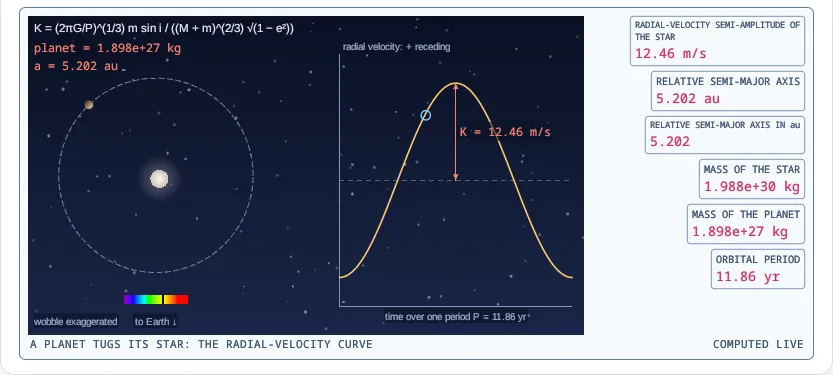 Radial-velocity semi-amplitude of a star |
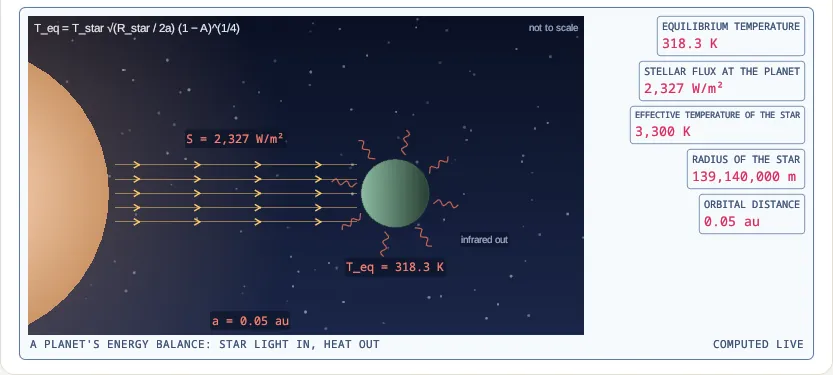 Equilibrium temperature of a planet |
Charts:
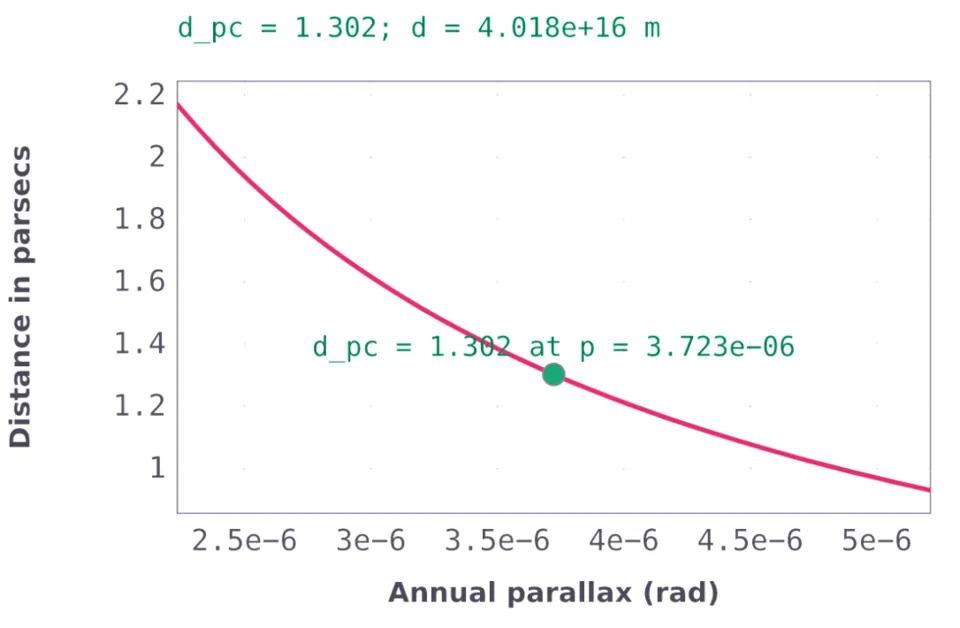 Distance from parallax |
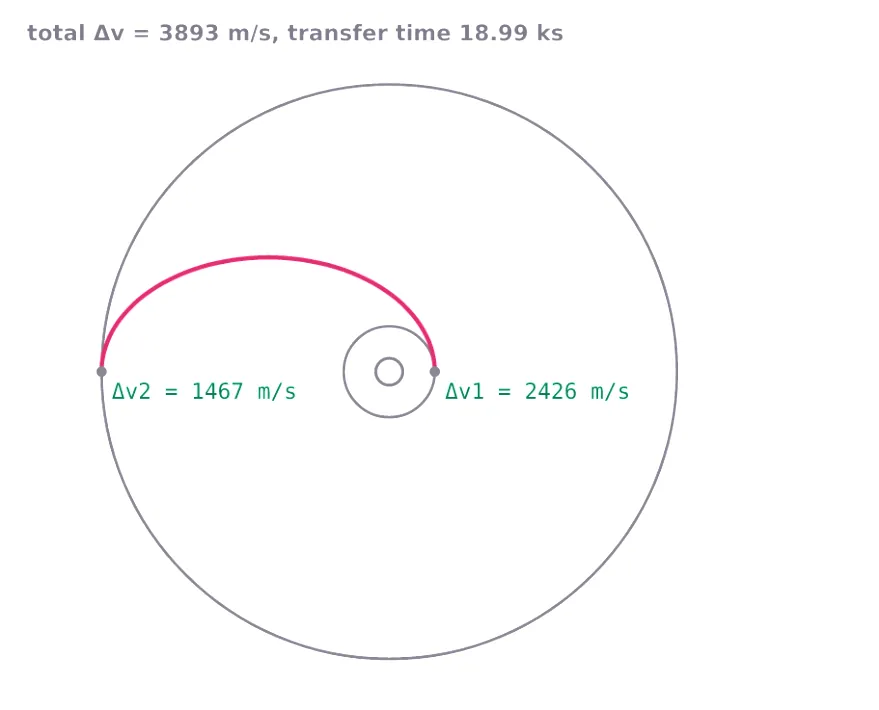 Hohmann transfer between circular orbits |
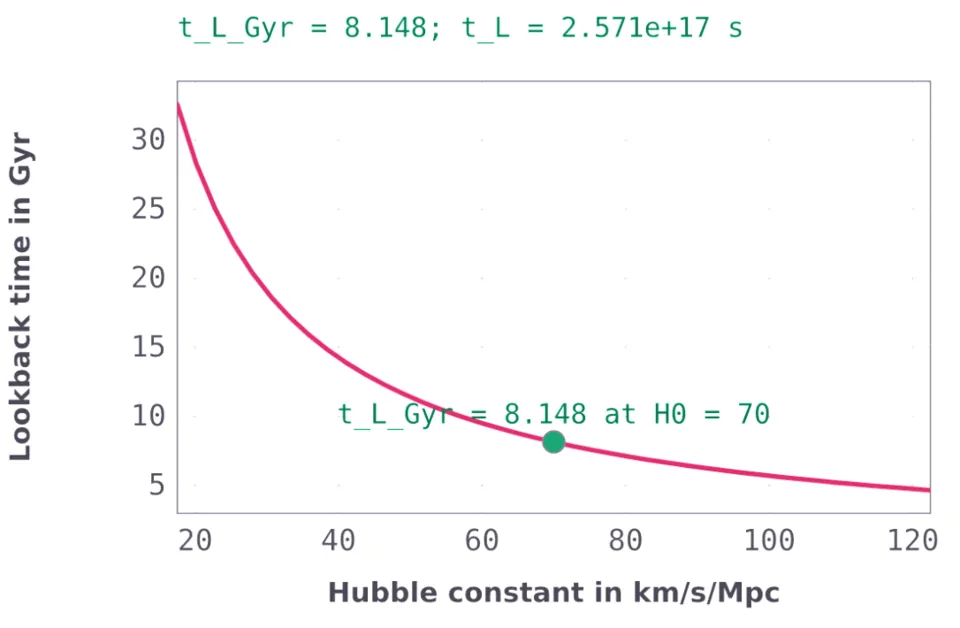 Lookback time to a redshift |
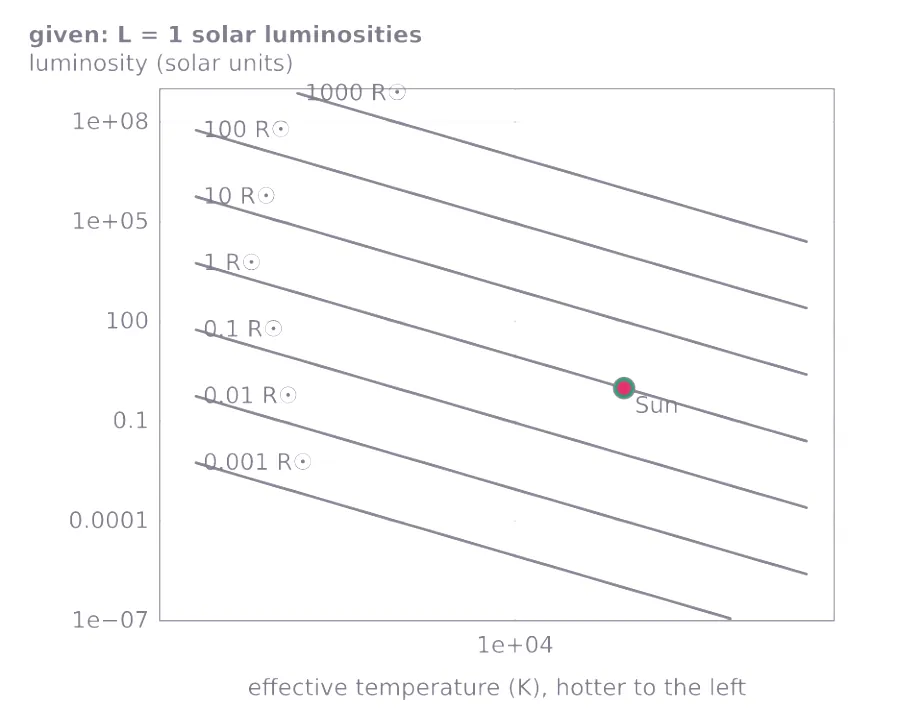 Luminosity of a star (Stefan-Boltzmann) |
Each question below was asked on this release; the comment under it is the line it printed.
import astronomy_ai999x as astronomy

a = astronomy.ask("Schwarzschild radius: M = 1 Msun")
print(a.outcome, a.values)
# SOLVED {'rs': 2953.2500761, 'rs_km': 2.9532500761, 'M_Msun': 1.0}

a = astronomy.ask("Absolute magnitude: m = 8, d = 100 pc, A = 1")
print(a.outcome, a.values)
# SOLVED {'M': 2.0, 'mu': 5.0, 'd_pc': 100.0}

a = astronomy.ask(
    "Radial velocity semi-amplitude: M_star = 1 Msun, m_p = 1 Mjup, P "
    "= 11.86 yr"
)
print(a.outcome, a.values)
# SOLVED {'K': 12.4597741631, 'a': 778241756142.0, 'a_au': 5.20222482112}

a = astronomy.ask("Airmass: zen = 60 deg")
print(a.outcome, a.values)
# SOLVED {'X': 2.0, 'alt_deg': 30.0}

a = astronomy.ask("Plane change: v1 = 3 km/s, v2 = 4 km/s, di = 90 deg")
print(a.outcome, a.values)
# SOLVED {'dv': 5000.0}

a = astronomy.ask(
    "Equilibrium temperature: T_star = 1000 K, R_star = 2 m, a = 4 m"
)
print(a.outcome, a.values)
# SOLVED {'T_eq': 500.0, 'S': 14175.936048}

a = astronomy.ask("Alfven speed: B = 5 nT, n = 5 cm^-3")
print(a.outcome, a.values)
# SOLVED {'v_A': 48759.9158597, 'v_A_km_s': 48.7599158597}

a = astronomy.ask(
    "Altitude-azimuth from hour angle: H = 0 h, dec = 0 deg, lat = 45 "
    "deg"
)
print(a.outcome, a.values)
# SOLVED {'alt_deg': 45.0, 'az_deg': 180.0}

a = astronomy.ask("Absolute bolometric magnitude: L = 1 Lsun")
print(a.outcome, a.values)
# SOLVED {'M_bol': 4.73999593392, 'L_Lsun': 1.0}

a = astronomy.ask("Rayleigh criterion: lam = 550 nm, D = 2.4 m")
print(a.outcome, a.values)
# SOLVED {'theta': 2.79507683415e-07, 'theta_arcsec': 0.0576525981642}

a = astronomy.ask("Calendar date from Julian date: jd = 2451545.0")
print(a.outcome, a.values)
# SOLVED {'year': 2000, 'month': 1, 'day': 1, 'hours': 12.0}

a = astronomy.ask(
    "Scale height: T = 288 K, mu = 28.97 g/mol, g = 9.81 m/s^2"
)
print(a.outcome, a.values)
# SOLVED {'H': 8425.76166363, 'H_km': 8.42576166363}

a = astronomy.ask("Debye length: T = 1e5 K, n = 1e18 m^-3")
print(a.outcome, a.values)
# SOLVED {'lambda_D': 2.18225558021e-05, 'lambda_D_nm': 21822.5558021}

a = astronomy.ask(
    "Apparent bolometric magnitude: L = 3.0128e28 W, d = 100 pc"
)
print(a.outcome, a.values)
# SOLVED {'m_bol': 5.0, 'F': 2.51802100263e-10, 'M_bol': 0.0}

a = astronomy.ask("Light-gathering power: D1 = 200 mm, D2 = 2 mm")
print(a.outcome, a.values)
# SOLVED {'area_ratio': 10000.0, 'mag_gain': 10.0}
Each command below was run with astronomy of this release; the lines under it are the answer it printed (the full answer goes on with the method, every input in SI units and the conditions it assumes).
$ astronomy solve schwarzschild_radius "M=1.988409871e+30 kg"
rs = 2953.250077 m
rs_km = 2.953250077
M_Msun = 1

$ astronomy solve age_at_redshift z=3 H0=70 Om=1
age = 3.673425692e+16 s
age_Gyr = 1.164038359
age_now_Gyr = 9.312306873

$ astronomy solve absolute_magnitude m=8 "d=3.085677581e+18 m" A=1
M = 2
mu = 5
d_pc = 99.99999998

$ astronomy solve radial_velocity_semi_amplitude "M_star=1.988409871e+30 kg" "m_p=1.898124597e+27 kg" "P=11.86 yr"
K = 12.45977416 m/s
a = 7.782417562e+11 m
a_au = 5.202224821

$ astronomy solve einstein_radius "M=9.942049353e+29 kg" "D_l=1.234271033e+20 m" "D_s=2.468542065e+20 m"
theta_E = 3.458835005e-09 rad
theta_E_arcsec = 0.0007134359322
R_E = 4.269139855e+11 m
R_E_au = 2.85374373

$ astronomy solve airmass_extinction "zen=60 deg"
X = 2
alt_deg = 30

$ astronomy solve plane_change_delta_v "v1=3 km/s" "v2=4 km/s" "di=90 deg"
dv = 5000 m/s

$ astronomy solve planet_equilibrium_temperature "T_star=1000 K" "R_star=2 m" "a=4 m"
T_eq = 500 K
S = 14175.93605 W/m^2

$ astronomy solve alfven_speed "B=5 nT" "n=5 cm^-3"
v_A = 48759.91586 m/s
v_A_km_s = 48.75991586

$ astronomy solve altaz_from_hadec "H=0 deg" "dec=0 deg" "lat=45 deg"
alt_deg = 45
az_deg = 180

$ astronomy solve bolometric_magnitude_from_luminosity "L=3.828e+26 W"
M_bol = 4.739995934
L_Lsun = 1

$ astronomy solve rayleigh_resolution "lam=550 nm" "D=2.4 m"
theta = 2.795076834e-07 rad
theta_arcsec = 0.05765259816

$ astronomy solve calendar_date_from_julian_date jd=2451545
year = 2000
month = 1
day = 1
hours = 12

$ astronomy solve angular_size_at_redshift z=3 H0=70 Om=1 "D=3.085677581e+22 m"
theta_arcsec = 192.6470937
scale_kpc_per_arcsec = 5.190838755
D_A_Mpc = 1070.68735

$ astronomy solve distance_unit_conversion "d=3.085677581e+16 m"
d_m = 3.085677581e+16 m
d_km = 3.085677581e+13
d_au = 206264.8062
d_ly = 3.261563777
d_pc = 0.9999999998
Every calculation, with its formula, a worked example and its figures: Astronomy on ai999x.com. Install guides for the app and the command line: https://www.ai999x.com/desktop-cli/.
Version 1.6.7 · License: Apache-2.0 · Author: Ibnul Jaif Farabi · Organization: AI999X · Contact: support@ai999x.com · Support the project
The Future Is Self-Improving.