

LLM-MIA-Datasets-Raw
Collection
11 items • Updated
year stringdate 1961-01-01 00:00:00 2025-01-01 00:00:00 ⌀ | tier stringclasses 5
values | problem_label stringclasses 119
values | problem_type stringclasses 13
values | exam stringclasses 28
values | problem stringlengths 87 2.77k | solution stringlengths 834 13k | metadata dict | problem_tokens int64 50 903 | solution_tokens int64 500 3.93k |
|---|---|---|---|---|---|---|---|---|---|
1989 | T1 | 2 | null | APMO | Prove that the equation
$$
6\left(6 a^{2}+3 b^{2}+c^{2}\right)=5 n^{2}
$$
has no solutions in integers except $a=b=c=n=0$. | We can suppose without loss of generality that $a, b, c, n \geq 0$. Let $(a, b, c, n)$ be a solution with minimum sum $a+b+c+n$. Suppose, for the sake of contradiction, that $a+b+c+n>0$. Since 6 divides $5 n^{2}, n$ is a multiple of 6 . Let $n=6 n_{0}$. Then the equation reduces to
$$
6 a^{2}+3 b^{2}+c^{2}=30 n_{0}^{2... | {
"problem_match": "# Problem 2",
"resource_path": "APMO/segmented/en-apmo1989_sol.jsonl",
"solution_match": "# Solution\n\n"
} | 51 | 749 |
1989 | T1 | 3 | null | APMO | Let $A_{1}, A_{2}, A_{3}$ be three points in the plane, and for convenience,let $A_{4}=A_{1}, A_{5}=A_{2}$. For $n=1,2$, and 3 , suppose that $B_{n}$ is the midpoint of $A_{n} A_{n+1}$, and suppose that $C_{n}$ is the midpoint of $A_{n} B_{n}$. Suppose that $A_{n} C_{n+1}$ and $B_{n} A_{n+2}$ meet at $D_{n}$, and that ... | Let $G$ be the centroid of triangle $A B C$, and also the intersection point of $A_{1} B_{2}, A_{2} B_{3}$, and $A_{3} B_{1}$ 。
By Menelao's theorem on triangle $B_{1} A_{2} A_{3}$ and line $A_{1} D_{1} C_{2}$,
$$
\frac{A_{1} B_{1}}{A_{1} A_{2}} \cdot \frac{D_{1} A_{3}}{D_{1} B_{1}} \cdot \frac{C_{2} A_{2}}{C_{2} A_{... | {
"problem_match": "# Problem 3",
"resource_path": "APMO/segmented/en-apmo1989_sol.jsonl",
"solution_match": "\nSolution\n"
} | 219 | 864 |
1989 | T1 | 4 | null | APMO | Let $S$ be a set consisting of $m$ pairs $(a, b)$ of positive integers with the property that $1 \leq a<$ $b \leq n$. Show that there are at least
$$
4 m \frac{\left(m-\frac{n^{2}}{4}\right)}{3 n}
$$
triples $(a, b, c)$ such that $(a, b),(a, c)$, and $(b, c)$ belong to $S$. | Call a triple $(a, b, c)$ good if and only if $(a, b),(a, c)$, and $(b, c)$ all belong to $S$. For $i$ in $\{1,2, \ldots, n\}$, let $d_{i}$ be the number of pairs in $S$ that contain $i$, and let $D_{i}$ be the set of numbers paired with $i$ in $S$ (so $\left|D_{i}\right|=d_{i}$ ). Consider a pair $(i, j) \in S$. Our g... | {
"problem_match": "# Problem 4",
"resource_path": "APMO/segmented/en-apmo1989_sol.jsonl",
"solution_match": "# Solution\n\n"
} | 104 | 742 |
1989 | T1 | 5 | null | APMO | Determine all functions $f$ from the reals to the reals for which
(1) $f(x)$ is strictly increasing,
(2) $f(x)+g(x)=2 x$ for all real $x$, where $g(x)$ is the composition inverse function to $f(x)$.
(Note: $f$ and $g$ are said to be composition inverses if $f(g(x))=x$ and $g(f(x))=x$ for all real x.)
Answer: $f(x)=x+c... | Denote by $f_{n}$ the $n$th iterate of $f$, that is, $f_{n}(x)=\underbrace{f(f(\ldots f}_{n \text { times }}(x)))$.
Plug $x \rightarrow f_{n+1}(x)$ in (2): since $g\left(f_{n+1}(x)\right)=g\left(f\left(f_{n}(x)\right)\right)=f_{n}(x)$,
$$
f_{n+2}(x)+f_{n}(x)=2 f_{n+1}(x)
$$
that is,
$$
f_{n+2}(x)-f_{n+1}(x)=f_{n+1}(... | {
"problem_match": "# Problem 5",
"resource_path": "APMO/segmented/en-apmo1989_sol.jsonl",
"solution_match": "# Solution\n\n"
} | 123 | 598 |
1990 | T1 | 1 | null | APMO | In $\triangle A B C$, let $D, E, F$ be the midpoints of $B C, A C, A B$ respectively and let $G$ be the centroid of the triangle.
For each value of $\angle B A C$, how many non-similar triangles are there in which $A E G F$ is a cyclic quadrilateral? | Let $I$ be the intersection of $A G$ and $E F$.
Let $\delta=A I . I G-F I$ IE. Then
$$
A I=A D / 2, \quad I G=A D / 6, \quad F I=B C / 4=I E
$$
Further, applying the cosine rule to triangles $A B D, A C D$ we get
$$
\begin{aligned}
A B^{2} & =B C^{2} / 4+A D^{2}-A D \cdot B C \cdot \cos \angle B D A, \\
A C^{2} & =B... | {
"problem_match": "# Question 1 ",
"resource_path": "APMO/segmented/en-apmo1990_sol.jsonl",
"solution_match": "# FIRST SOLUTION\n\n"
} | 75 | 571 |
1990 | T1 | 1 | null | APMO | In $\triangle A B C$, let $D, E, F$ be the midpoints of $B C, A C, A B$ respectively and let $G$ be the centroid of the triangle.
For each value of $\angle B A C$, how many non-similar triangles are there in which $A E G F$ is a cyclic quadrilateral? | in the figure as shown below, we first show that it is necessary that $\angle A$ is less than $90^{\circ}$ if the quadrilateral $A E G F$ ; cyclic.
Now, since $E F \| B C$, we get
$$
\begin{aligned}
\angle E G F & =180^{\circ}-\left(B_{1}+C_{1}\right) \\
& \geq 180^{\circ}-(B+C) \\
& =A .
\end{aligned}
$$
(1)
Thus,... | {
"problem_match": "# Question 1 ",
"resource_path": "APMO/segmented/en-apmo1990_sol.jsonl",
"solution_match": "\nTHIRD SOLUTION\n"
} | 75 | 1,379 |
1990 | T1 | 2 | null | APMO | Let $a_{1}, a_{2}, \ldots, a_{n}$ be positive real numbers, and let $S_{k}$ be the sum of products of $a_{1}, a_{2}, \ldots, a_{n}$ taken $k$ at a time.
Show that
$$
S_{k} S_{n-k} \geq\binom{ n}{k}^{2} a_{1} a_{2} \ldots a_{n}, \quad \text { for } \quad k=1,2, \ldots, n-1
$$ | (provided by the Canadian Problems Committee).
Write $S_{k}$ as $\sum_{i=1}^{\binom{n}{k}} t_{i}$. Then
주
$$
S_{n-k}=\left(\prod_{m=1}^{n} a_{m}\right)\left(\sum_{i=1}^{\binom{n}{k}} \frac{1}{t_{i}}\right)
$$
$$
\text { so that } \left.\begin{array}{rl}
S_{k} S_{n-k} & =\left(\prod_{m=1}^{n} a_{m}\right) \cdot\left(\... | {
"problem_match": "# Question 2",
"resource_path": "APMO/segmented/en-apmo1990_sol.jsonl",
"solution_match": "\nSECOND SOLUTION "
} | 128 | 512 |
1990 | T1 | 4 | null | APMO | A set of 1990 persons is divided into non-intersecting subsets in such a way that
(a) no one in a subset knows all the others in the subset;
(b) among any three persons in a subset, there are always at least two who do not know each other; and
(c) for any two persons in a subset who do not know each other, there is exa... | (i) Let $S$ be a subset of persons satisfying conditions (a), (b) and (c). Let $x \in S$ be one who knows the maximum number of persons in $S$.
Assume that $x$ knows $x_{1}, x_{2}, \ldots, x_{n}$. By (b), $x_{i}$ and $x_{j}$ are strangers if $i \neq j$. For each $x_{i}$, let $N_{i}$ be the set of persons in $S$ who kno... | {
"problem_match": "# Question 4",
"resource_path": "APMO/segmented/en-apmo1990_sol.jsonl",
"solution_match": "# SOLUTION:"
} | 169 | 550 |
1991 | T1 | 4 | null | APMO | During a break, $n$ children at school sit in a circle around their teacher to play a game. The teacher walks clockwise close to the children and hands out candies to some of them according to the following rule. He selects one child and gives him a candy, then he skips the next child and gives a candy to the next one,... | Number the children from 0 to $n-1$. Then the teacher hands candy to children in positions $f(x)=1+2+\cdots+x \bmod n=\frac{x(x+1)}{2} \bmod n$. Our task is to find the range of $f: \mathbb{Z}_{n} \rightarrow \mathbb{Z}_{n}$, and to verify whether the range is $\mathbb{Z}_{n}$, that is, whether $f$ is a bijection.
If $... | {
"problem_match": "# Problem 4",
"resource_path": "APMO/segmented/en-apmo1991_sol.jsonl",
"solution_match": "# Solution 1"
} | 126 | 619 |
1991 | T1 | 4 | null | APMO | During a break, $n$ children at school sit in a circle around their teacher to play a game. The teacher walks clockwise close to the children and hands out candies to some of them according to the following rule. He selects one child and gives him a candy, then he skips the next child and gives a candy to the next one,... | We give a full description of $a_{n}$, the size of the range of $f$.
Since congruences modulo $n$ are defined, via Chinese Remainder Theorem, by congruences modulo $p^{\alpha}$ for all prime divisors $p$ of $n$ and $\alpha$ being the number of factors $p$ in the factorization of $n, a_{n}=\prod_{p^{\alpha} \| n} a_{p^{... | {
"problem_match": "# Problem 4",
"resource_path": "APMO/segmented/en-apmo1991_sol.jsonl",
"solution_match": "# Solution 2"
} | 126 | 717 |
1992 | T1 | 3 | null | APMO | Let $n$ be an integer such that $n>3$. Suppose that we choose three numbers from the set $\{1,2, \ldots, n\}$. Using each of these three numbers only once and using addition, multiplication, and parenthesis, let us form all possible combinations.
(a) Show that if we choose all three numbers greater than $n / 2$, then t... | In both items, the smallest chosen number is at least 2: in part (a), $n / 2>1$ and in part (b), $p$ is a prime. So let $1<x<y<z$ be the chosen numbers. Then all possible combinations are
$$
x+y+z, \quad x+y z, \quad x y+z, \quad y+z x, \quad(x+y) z, \quad(z+x) y, \quad(x+y) z, \quad x y z
$$
Since, for $1<m<n$ and $... | {
"problem_match": "# Problem 3",
"resource_path": "APMO/segmented/en-apmo1992_sol.jsonl",
"solution_match": "# Solution\n\n"
} | 154 | 666 |
1992 | T1 | 4 | null | APMO | Determine all pairs $(h, s)$ of positive integers with the following property: If one draws $h$ horizontal lines and another $s$ lines which satisfy
(i) they are not horizontal,
(ii) no two of them are parallel,
(iii) no three of the $h+s$ lines are concurrent,
then the number of regions formed by these $h+s$ lines is ... | Let $a_{h, s}$ the number of regions formed by $h$ horizontal lines and $s$ another lines as described in the problem. Let $\mathcal{F}_{h, s}$ be the union of the $h+s$ lines and pick any line $\ell$. If it intersects the other lines in $n$ (distinct!) points then $\ell$ is partitioned into $n-1$ line segments and 2 r... | {
"problem_match": "# Problem 4",
"resource_path": "APMO/segmented/en-apmo1992_sol.jsonl",
"solution_match": "# Solution\n\n"
} | 111 | 524 |
1992 | T1 | 5 | null | APMO | Find a sequence of maximal length consisting of non-zero integers in which the sum of any seven consecutive terms is positive and that of any eleven consecutive terms is negative.
Answer: The maximum length is 16 . There are several possible sequences with this length; one such sequence is $(-7,-7,18,-7,-7,-7,18,-7,-7... | Suppose it is possible to have more than 16 terms in the sequence. Let $a_{1}, a_{2}, \ldots, a_{17}$ be the first 17 terms of the sequence. Consider the following array of terms in the sequence:
| $a_{1}$ | $a_{2}$ | $a_{3}$ | $a_{4}$ | $a_{5}$ | $a_{6}$ | $a_{7}$ | $a_{8}$ | $a_{9}$ | $a_{10}$ | $a_{11}$ |
| :---: |... | {
"problem_match": "# Problem 5",
"resource_path": "APMO/segmented/en-apmo1992_sol.jsonl",
"solution_match": "# Solution\n\n"
} | 94 | 913 |
1993 | T1 | 2 | null | APMO | Find the total number of different integer values the function
$$
f(x)=[x]+[2 x]+\left[\frac{5 x}{3}\right]+[3 x]+[4 x]
$$
takes for real numbers $x$ with $0 \leq x \leq 100$.
Note: $[t]$ is the largest integer that does not exceed $t$.
Answer: 734. | Note that, since $[x+n]=[x]+n$ for any integer $n$,
$$
f(x+3)=[x+3]+[2(x+3)]+\left[\frac{5(x+3)}{3}\right]+[3(x+3)]+[4(x+3)]=f(x)+35,
$$
one only needs to investigate the interval $[0,3)$.
The numbers in this interval at which at least one of the real numbers $x, 2 x, \frac{5 x}{3}, 3 x, 4 x$ is an integer are
- $0,... | {
"problem_match": "# Problem 2",
"resource_path": "APMO/segmented/en-apmo1993_sol.jsonl",
"solution_match": "# Solution\n\n"
} | 92 | 691 |
1993 | T1 | 3 | null | APMO | Let
$$
f(x)=a_{n} x^{n}+a_{n-1} x^{n-1}+\cdots+a_{0} \quad \text { and } \quad g(x)=c_{n+1} x^{n+1}+c_{n} x^{n}+\cdots+c_{0}
$$
be non-zero polynomials with real coefficients such that $g(x)=(x+r) f(x)$ for some real number $r$. If $a=\max \left(\left|a_{n}\right|, \ldots,\left|a_{0}\right|\right)$ and $c=\max \left(... | Expanding $(x+r) f(x)$, we find that $c_{n+1}=a_{n}, c_{k}=a_{k-1}+r a_{k}$ for $k=1,2, \ldots, n$, and $c_{0}=r a_{0}$. Consider three cases:
- $r=0$. Then $c_{0}=0$ and $c_{k}=a_{k-1}$ for $k=1,2, \ldots, n$, and $a=c \Longrightarrow \frac{a}{c}=1 \leq n+1$.
- $|r| \geq 1$. Then
$$
\begin{gathered}
\left|a_{0}\righ... | {
"problem_match": "# Problem 3",
"resource_path": "APMO/segmented/en-apmo1993_sol.jsonl",
"solution_match": "# Solution\n\n"
} | 185 | 643 |
1994 | T1 | 1 | null | APMO | Let $f: \mathbb{R} \rightarrow \mathbb{R}$ be a function such that
(i) For all $x, y \in \mathbb{R}$,
$$
f(x)+f(y)+1 \geq f(x+y) \geq f(x)+f(y)
$$
(ii) For all $x \in[0,1), f(0) \geq f(x)$,
(iii) $-f(-1)=f(1)=1$.
Find all such functions $f$.
Answer: $f(x)=\lfloor x\rfloor$, the largest integer that does not exceed $... | Plug $y \rightarrow 1$ in (i):
$$
f(x)+f(1)+1 \geq f(x+1) \geq f(x)+f(1) \Longleftrightarrow f(x)+1 \leq f(x+1) \leq f(x)+2
$$
Now plug $y \rightarrow-1$ and $x \rightarrow x+1$ in (i):
$$
f(x+1)+f(-1)+1 \geq f(x) \geq f(x+1)+f(-1) \Longleftrightarrow f(x) \leq f(x+1) \leq f(x)+1
$$
Hence $f(x+1)=f(x)+1$ and we onl... | {
"problem_match": "# Problem 1",
"resource_path": "APMO/segmented/en-apmo1994_sol.jsonl",
"solution_match": "# Solution\n\n"
} | 145 | 548 |
1994 | T1 | 3 | null | APMO | Let $n$ be an integer of the form $a^{2}+b^{2}$, where $a$ and $b$ are relatively prime integers and such that if $p$ is a prime, $p \leq \sqrt{n}$, then $p$ divides $a b$. Determine all such $n$.
Answer: $n=2,5,13$. | A prime $p$ divides $a b$ if and only if divides either $a$ or $b$. If $n=a^{2}+b^{2}$ is a composite then it has a prime divisor $p \leq \sqrt{n}$, and if $p$ divides $a$ it divides $b$ and vice-versa, which is not possible because $a$ and $b$ are coprime. Therefore $n$ is a prime.
Suppose without loss of generality t... | {
"problem_match": "# Problem 3",
"resource_path": "APMO/segmented/en-apmo1994_sol.jsonl",
"solution_match": "# Solution\n\n"
} | 82 | 721 |
1994 | T1 | 5 | null | APMO | You are given three lists $A, B$, and $C$. List $A$ contains the numbers of the form $10^{k}$ in base 10, with $k$ any integer greater than or equal to 1 . Lists $B$ and $C$ contain the same numbers translated into base 2 and 5 respectively:
| $A$ | $B$ | $C$ |
| :--- | :--- | :--- |
| 10 | 1010 | 20 |
| 100 | 1100100... | Let $b_{k}$ and $c_{k}$ be the number of digits in the $k$ th term in lists $B$ and $C$, respectively. Then
$$
2^{b_{k}-1} \leq 10^{k}<2^{b_{k}} \Longleftrightarrow \log _{2} 10^{k}<b_{k} \leq \log _{2} 10^{k}+1 \Longleftrightarrow b_{k}=\left\lfloor k \cdot \log _{2} 10\right\rfloor+1
$$
and, similarly
$$
c_{k}=\le... | {
"problem_match": "# Problem 5",
"resource_path": "APMO/segmented/en-apmo1994_sol.jsonl",
"solution_match": "# Solution\n\n"
} | 209 | 899 |
1999 | T1 | 5 | null | APMO | Let $S$ be a set of $2 n+1$ points in the plane such that no three are collinear and no four concyclic. A circle will be called good if it has 3 points of $S$ on its circumference, $n-1$ points in its interior and $n-1$ in its exterior. Prove that the number of good circles has the same parity as $n$. | and Marking Scheme:
Lemma 1. Let $P$ and $Q$ be two points of $S$. The number of good circles that contain $P$ and $Q$ on their circumference is odd.
## Proof of Lemma 1.
Let $N$ be the number of good circles that pass through $P$ and $Q$. Number the points on one side of the line $P Q$ by $A_{1}, A_{2}, \ldots, A_{... | {
"problem_match": "\nProblem 5.",
"resource_path": "APMO/segmented/en-apmo1999_sol.jsonl",
"solution_match": "# Solution "
} | 86 | 3,594 |
2000 | T1 | 2 | null | APMO | Given the following arrangement of circles:
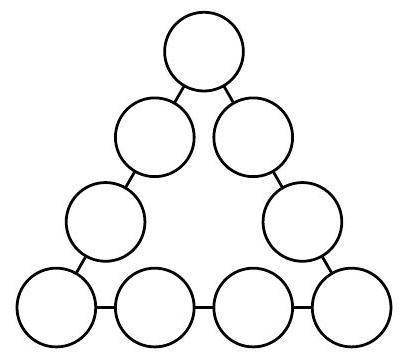
Each of the numbers $1,2, \ldots, 9$ is to be written into one of these circles, so that each circle contains exactly one of these numbers and
(i) t... | Let $a, b$, and $c$ be the numbers in the vertices of the triangular arrangement. Let $s$ be the sum of the numbers on each side and $t$ be the sum of the squares of the numbers on each side. Summing the numbers (or their squares) on the three sides repeats each once the numbers on the vertices (or their squares):
$$
... | {
"problem_match": "# Problem 2",
"resource_path": "APMO/segmented/en-apmo2000_sol.jsonl",
"solution_match": "# Solution\n\n"
} | 264 | 1,062 |
2000 | T1 | 3 | null | APMO | Let $A B C$ be a triangle. Let $M$ and $N$ be the points in which the median and angle bisector, respectively, at $A$ meet the side $B C$. Let $Q$ and $P$ be the points in which the perpendicular at $N$ to $N A$ meets $M A$ and $B A$, respectively, and $O$ be the point in which the perpendicular at $P$ to $B A$ meets $... | Consider a cartesian plane with $A=(0,0)$ as the origin and the bisector $A N$ as $x$-axis. Thus $A B$ has equation $y=m x$ and $A C$ has equation $y=-m x$. Let $B=(b, m b)$ and $C=(c,-m c)$. By symmetry, the problem is immediate if $A B=A C$, that is, if $b=c$. Suppose that $b \neq c$ from now on. Line $B C$ has slope... | {
"problem_match": "# Problem 3",
"resource_path": "APMO/segmented/en-apmo2000_sol.jsonl",
"solution_match": "# Solution 2"
} | 120 | 563 |
2000 | T1 | 4 | null | APMO | Let $n, k$ be given positive integers with $n>k$. Prove that
$$
\frac{1}{n+1} \cdot \frac{n^{n}}{k^{k}(n-k)^{n-k}}<\frac{n!}{k!(n-k)!}<\frac{n^{n}}{k^{k}(n-k)^{n-k}} .
$$ | The inequality is equivalent to
$$
\frac{n^{n}}{n+1}<\binom{n}{k} k^{k}(n-k)^{n-k}<n^{n}
$$
which suggests investigating the binomial expansion of
$$
n^{n}=((n-k)+k)^{n}=\sum_{i=0}^{n}\binom{n}{i}(n-k)^{n-i} k^{i}
$$
The $(k+1)$ th term $T_{k+1}$ of the expansion is $\binom{n}{k} k^{k}(n-k)^{n-k}$, and all terms in... | {
"problem_match": "# Problem 4",
"resource_path": "APMO/segmented/en-apmo2000_sol.jsonl",
"solution_match": "# Solution\n\n"
} | 82 | 639 |
2000 | T1 | 5 | null | APMO | Given a permutation $\left(a_{0}, a_{1}, \ldots, a_{n}\right)$ of the sequence $0,1, \ldots, n$. A transposition of $a_{i}$ with $a_{j}$ is called legal if $a_{i}=0$ for $i>0$, and $a_{i-1}+1=a_{j}$. The permutation $\left(a_{0}, a_{1}, \ldots, a_{n}\right)$ is called regular if after a number of legal transpositions i... | A legal transposition consists of looking at the number immediately before 0 and exchanging 0 and its successor; therefore, we can perform at most one legal transposition to any permutation, and a legal transposition is not possible only and if only 0 is preceded by $n$.
If $n=1$ or $n=2$ there is nothing to do, so $n=... | {
"problem_match": "# Problem 5",
"resource_path": "APMO/segmented/en-apmo2000_sol.jsonl",
"solution_match": "# Solution\n\n"
} | 187 | 2,361 |
2002 | T1 | 1 | null | APMO | Let $a_{1}, a_{2}, a_{3}, \ldots, a_{n}$ be a sequence of non-negative integers, where $n$ is a positive integer.
Let
$$
A_{n}=\frac{a_{1}+a_{2}+\cdots+a_{n}}{n}
$$
Prove that
$$
a_{1}!a_{2}!\ldots a_{n}!\geq\left(\left\lfloor A_{n}\right\rfloor!\right)^{n}
$$
where $\left\lfloor A_{n}\right\rfloor$ is the greates... | Assume without loss of generality that $a_{1} \geq a_{2} \geq \cdots \geq a_{n} \geq 0$, and let $s=\left\lfloor A_{n}\right\rfloor$. Let $k$ be any (fixed) index for which $a_{k} \geq s \geq a_{k+1}$.
Our inequality is equivalent to proving that
$$
\frac{a_{1}!}{s!} \cdot \frac{a_{2}!}{s!} \cdot \ldots \cdot \frac{a... | {
"problem_match": "\n1. ",
"resource_path": "APMO/segmented/en-apmo2002_sol.jsonl",
"solution_match": "# Solution 1."
} | 189 | 537 |
2002 | T1 | 1 | null | APMO | Let $a_{1}, a_{2}, a_{3}, \ldots, a_{n}$ be a sequence of non-negative integers, where $n$ is a positive integer.
Let
$$
A_{n}=\frac{a_{1}+a_{2}+\cdots+a_{n}}{n}
$$
Prove that
$$
a_{1}!a_{2}!\ldots a_{n}!\geq\left(\left\lfloor A_{n}\right\rfloor!\right)^{n}
$$
where $\left\lfloor A_{n}\right\rfloor$ is the greates... | Assume without loss of generality that $0 \leq a_{1} \leq a_{2} \leq \cdots \leq a_{n}$. Let $d=a_{n}-a_{1}$ and $m=\left|\left\{i: a_{i}=a_{1}\right\}\right|$. Our proof is by induction on $d$.
We first do the case $d=a_{n}-a_{1}=0$ or 1 separately. Then $a_{1}=a_{2}=\cdots=a_{m}=a$ and $a_{m+1}=\cdots=a_{n}=a+1$ for... | {
"problem_match": "\n1. ",
"resource_path": "APMO/segmented/en-apmo2002_sol.jsonl",
"solution_match": "\nSolution 2."
} | 189 | 628 |
2002 | T1 | 2 | null | APMO | Find all positive integers $a$ and $b$ such that
$$
\frac{a^{2}+b}{b^{2}-a} \text { and } \frac{b^{2}+a}{a^{2}-b}
$$
are both integers. | By the symmetry of the problem, we may suppose that $a \leq b$. Notice that $b^{2}-a \geq 0$, so that if $\frac{a^{2}+b}{b^{2}-a}$ is a positive integer, then $a^{2}+b \geq b^{2}-a$. Rearranging this inequality and factorizing, we find that $(a+b)(a-b+1) \geq 0$. Since $a, b>0$, we must have $a \geq b-1$. [3 marks to h... | {
"problem_match": "\n2. ",
"resource_path": "APMO/segmented/en-apmo2002_sol.jsonl",
"solution_match": "\nSolution."
} | 59 | 570 |
2002 | T1 | 3 | null | APMO | Let $A B C$ be an equilateral triangle. Let $P$ be a point on the side $A C$ and $Q$ be a point on the side $A B$ so that both triangles $A B P$ and $A C Q$ are acute. Let $R$ be the orthocentre of triangle $A B P$ and $S$ be the orthocentre of triangle $A C Q$. Let $T$ be the point common to the segments $B P$ and $C ... | We are going to show that this can only happen when
$$
\angle C B P=\angle B C Q=15^{\circ} .
$$
Lemma. If $\angle C B P>\angle B C Q$, then $R T>S T$.
Proof. Let $A D, B E$ and $C F$ be the altitudes of triangle $A B C$ concurrent at its centre $G$. Then $P$ lies on $C E, Q$ lies on $B F$, and thus $T$ lies in trian... | {
"problem_match": "\n3. ",
"resource_path": "APMO/segmented/en-apmo2002_sol.jsonl",
"solution_match": "# Solution."
} | 140 | 714 |
2002 | T1 | 4 | null | APMO | Let $x, y, z$ be positive numbers such that
$$
\frac{1}{x}+\frac{1}{y}+\frac{1}{z}=1
$$
Show that
$$
\sqrt{x+y z}+\sqrt{y+z x}+\sqrt{z+x y} \geq \sqrt{x y z}+\sqrt{x}+\sqrt{y}+\sqrt{z}
$$ | This is another way of presenting the idea in the first solution.
Using the condition $\frac{1}{x}+\frac{1}{y}+\frac{1}{z}=1$ and the AM-GM inequality, we have
$$
\begin{aligned}
x+y z-\left(\sqrt{\frac{y z}{x}}+\sqrt{x}\right)^{2} & =y z\left(1-\frac{1}{x}\right)-2 \sqrt{y z} \\
& =y z\left(\frac{1}{y}+\frac{1}{z}\ri... | {
"problem_match": "\n4. ",
"resource_path": "APMO/segmented/en-apmo2002_sol.jsonl",
"solution_match": "\nSolution 3."
} | 90 | 509 |
2002 | T1 | 4 | null | APMO | Let $x, y, z$ be positive numbers such that
$$
\frac{1}{x}+\frac{1}{y}+\frac{1}{z}=1
$$
Show that
$$
\sqrt{x+y z}+\sqrt{y+z x}+\sqrt{z+x y} \geq \sqrt{x y z}+\sqrt{x}+\sqrt{y}+\sqrt{z}
$$ | This is also another way of presenting the idea in the first solution.
We make the substitution $a=\frac{1}{x}, b=\frac{1}{y}, c=\frac{1}{z}$. Then it is enough to show that
$$
\sqrt{\frac{1}{a}+\frac{1}{b c}}+\sqrt{\frac{1}{b}+\frac{1}{c a}}+\sqrt{\frac{1}{c}+\frac{1}{a b}} \geq \sqrt{\frac{1}{a b c}}+\sqrt{\frac{1}{... | {
"problem_match": "\n4. ",
"resource_path": "APMO/segmented/en-apmo2002_sol.jsonl",
"solution_match": "# Solution 4."
} | 90 | 564 |
2002 | T1 | 5 | null | APMO | Let R denote the set of all real numbers. Find all functions $f$ from R to R satisfying:
(i) there are only finitely many $s$ in R such that $f(s)=0$, and
(ii) $f\left(x^{4}+y\right)=x^{3} f(x)+f(f(y))$ for all $x, y$ in $\mathbf{R}$. | The only such function is the identity function on $R$.
Setting $(x, y)=(1,0)$ in the given functional equation (ii), we have $f(f(0))=0$. Setting $x=0$ in (ii), we find
$$
f(y)=f(f(y))
$$
[1 mark.] and thus $f(0)=f(f(0))=0$ [1 mark.]. It follows from (ii) that $f\left(x^{4}+y\right)=$ $x^{3} f(x)+f(y)$ for all $x, y... | {
"problem_match": "\n5. ",
"resource_path": "APMO/segmented/en-apmo2002_sol.jsonl",
"solution_match": "# Solution 1."
} | 88 | 842 |
2002 | T1 | 5 | null | APMO | Let R denote the set of all real numbers. Find all functions $f$ from R to R satisfying:
(i) there are only finitely many $s$ in R such that $f(s)=0$, and
(ii) $f\left(x^{4}+y\right)=x^{3} f(x)+f(f(y))$ for all $x, y$ in $\mathbf{R}$. | Again, the only such function is the identity function on R .
As in Solution 1, we first show that $f(f(y))=f(y), f(0)=0$, and $f\left(x^{4}\right)=x^{3} f(x)$. [2 marks.] From the latter follows
$$
f(x)=0 \Longrightarrow f\left(x^{4}\right)=0
$$
and from condition (i) we get that $f(x)=0$ only possibly for $x \in\{0... | {
"problem_match": "\n5. ",
"resource_path": "APMO/segmented/en-apmo2002_sol.jsonl",
"solution_match": "# Solution 2."
} | 88 | 693 |
2003 | T1 | 1 | null | APMO | Let $a, b, c, d, e, f$ be real numbers such that the polynomial
$$
p(x)=x^{8}-4 x^{7}+7 x^{6}+a x^{5}+b x^{4}+c x^{3}+d x^{2}+e x+f
$$
factorises into eight linear factors $x-x_{i}$, with $x_{i}>0$ for $i=1,2, \ldots, 8$. Determine all possible values of $f$. | From
$$
x^{8}-4 x^{7}+7 x^{6}+a x^{5}+b x^{4}+c x^{3}+d x^{2}+e x+f=\left(x-x_{1}\right)\left(x-x_{2}\right) \ldots\left(x-x_{8}\right)
$$
we have
$$
\sum_{i=1}^{8} x_{i}=4 \quad \text { and } \quad \sum x_{i} x_{j}=7
$$
where the second sum is over all pairs $(i, j)$ of integers where $1 \leq i<j \leq 8$. Since th... | {
"problem_match": "\n1. ",
"resource_path": "APMO/segmented/en-apmo2003_sol.jsonl",
"solution_match": "# Solution."
} | 117 | 769 |
2003 | T1 | 2 | null | APMO | Suppose $A B C D$ is a square piece of cardboard with side length $a$. On a plane are two parallel lines $\ell_{1}$ and $\ell_{2}$, which are also $a$ units apart. The square $A B C D$ is placed on the plane so that sides $A B$ and $A D$ intersect $\ell_{1}$ at $E$ and $F$ respectively. Also, sides $C B$ and $C D$ inte... | Without loss of generality, assume the square has side $a=1$. Let $\theta$ be the acute angle between $\ell_{1}$ (or $\ell_{2}$ ) and the sides $A B$ and $C D$ of the square. Then, letting $E F=x$ and $G H=y$, we have
$$
E A=x \cos \theta, \quad A F=x \sin \theta, \quad C H=y \cos \theta, \quad C G=y \sin \theta
$$
T... | {
"problem_match": "\n2. ",
"resource_path": "APMO/segmented/en-apmo2003_sol.jsonl",
"solution_match": "\nSolution 3."
} | 173 | 552 |
2003 | T1 | 3 | null | APMO | Let $k \geq 14$ be an integer, and let $p_{k}$ be the largest prime number which is strictly less than $k$. You may assume that $p_{k} \geq 3 k / 4$. Let $n$ be a composite integer. Prove:
(a) if $n=2 p_{k}$, then $n$ does not divide $(n-k)$ !;
(b) if $n>2 p_{k}$, then $n$ divides $(n-k)$ !. | (a) Note that $n-k=2 p_{k}-k<2 p_{k}-p_{k}=p_{k}$, so $p_{k} \nmid(n-k)$ !, so $2 p_{k} \nless(n-k)$ !. [1 mark]
(b) Note that $n>2 p_{k} \geq 3 k / 2$ implies $k<2 n / 3$, so $n-k>n / 3$. So if we can find integers $a, b \geq 3$ such that $n=a b$ and $a \neq b$, then both $a$ and $b$ will appear separately in the prod... | {
"problem_match": "\n3. ",
"resource_path": "APMO/segmented/en-apmo2003_sol.jsonl",
"solution_match": "\nSolution."
} | 113 | 530 |
2003 | T1 | 4 | null | APMO | Let $a, b, c$ be the sides of a triangle, with $a+b+c=1$, and let $n \geq 2$ be an integer. Show that
$$
\sqrt[n]{a^{n}+b^{n}}+\sqrt[n]{b^{n}+c^{n}}+\sqrt[n]{c^{n}+a^{n}}<1+\frac{\sqrt[n]{2}}{2}
$$ | Without loss of generality, assume $a \leq b \leq c$. As $a+b>c$, we have
$$
\frac{\sqrt[n]{2}}{2}=\frac{\sqrt[n]{2}}{2}(a+b+c)>\frac{\sqrt[n]{2}}{2}(c+c)=\sqrt[n]{2 c^{n}} \geq \sqrt[n]{b^{n}+c^{n}} \quad \quad[2 \text { marks }]
$$
As $a \leq c$ and $n \geq 2$, we have
$$
\begin{aligned}
\left(c^{n}+a^{n}\right)-\... | {
"problem_match": "\n4. ",
"resource_path": "APMO/segmented/en-apmo2003_sol.jsonl",
"solution_match": "# Solution."
} | 95 | 517 |
2003 | T1 | 5 | null | APMO | Given two positive integers $m$ and $n$, find the smallest positive integer $k$ such that among any $k$ people, either there are $2 m$ of them who form $m$ pairs of mutually acquainted people or there are $2 n$ of them forming $n$ pairs of mutually unacquainted people. | Let the smallest positive integer $k$ satisfying the condition of the problem be denoted $r(m, n)$. We shall show that
$$
r(m, n)=2(m+n)-\min \{m, n\}-1
$$
Observe that, by symmetry, $r(m, n)=r(n, m)$. Therefore it suffices to consider the case where $m \geq n$, and to prove that
$$
r(m, n)=2 m+n-1 . \quad[1 \text {... | {
"problem_match": "\n5. ",
"resource_path": "APMO/segmented/en-apmo2003_sol.jsonl",
"solution_match": "# Solution."
} | 69 | 878 |
2004 | T1 | 2 | null | APMO | Let $O$ be the circumcentre and $H$ the orthocentre of an acute triangle $A B C$. Prove that the area of one of the triangles $\mathrm{AOH}, \mathrm{BOH}$ and COH is equal to the sum of the areas of the other two. | One can use barycentric coordinates: it is well known that
$$
\begin{gathered}
A=(1: 0: 0), \quad B=(0: 1: 0), \quad C=(0: 0: 1), \\
O=(\sin 2 A: \sin 2 B: \sin 2 C) \quad \text { and } \quad H=(\tan A: \tan B: \tan C) .
\end{gathered}
$$
Then the (signed) area of $A O H$ is proportional to
$$
\left|\begin{array}{cc... | {
"problem_match": "# Problem 2",
"resource_path": "APMO/segmented/en-apmo2004_sol.jsonl",
"solution_match": "# Solution 2"
} | 63 | 583 |
2004 | T1 | 3 | null | APMO | Let a set $S$ of 2004 points in the plane be given, no three of which are collinear. Let $\mathcal{L}$ denote the set of all lines (extended indefinitely in both directions) determined by pairs of points from the set. Show that it is possible to colour the points of $S$ with at most two colours, such that for any point... | Choose any point $p$ from $S$ and color it, say, blue. Let $n(q, r)$ be the number of lines from $\mathcal{L}$ that separates $q$ and $r$. Then color any other point $q$ blue if $n(p, q)$ is odd and red if $n(p, q)$ is even.
Now it remains to show that $q$ and $r$ have the same color if and only if $n(q, r)$ is odd for... | {
"problem_match": "# Problem 3",
"resource_path": "APMO/segmented/en-apmo2004_sol.jsonl",
"solution_match": "# Solution\n\n"
} | 167 | 585 |
2004 | T1 | 4 | null | APMO | For a real number $x$, let $\lfloor x\rfloor$ stand for the largest integer that is less than or equal to $x$. Prove that
$$
\left\lfloor\frac{(n-1)!}{n(n+1)}\right\rfloor
$$
is even for every positive integer $n$. | Consider four cases:
- $n \leq 5$. Then $\left\lfloor\frac{(n-1)!}{n(n+1)}\right\rfloor=0$ is an even number.
- $n$ and $n+1$ are both composite (in particular, $n \geq 8$ ). Then $n=a b$ and $n+1=c d$ for $a, b, c, d \geq 2$. Moreover, since $n$ and $n+1$ are coprime, $a, b, c, d$ are all distinct and smaller than $n... | {
"problem_match": "# Problem 4",
"resource_path": "APMO/segmented/en-apmo2004_sol.jsonl",
"solution_match": "# Solution\n\n"
} | 72 | 702 |
2004 | T1 | 5 | null | APMO | Prove that
$$
\left(a^{2}+2\right)\left(b^{2}+2\right)\left(c^{2}+2\right) \geq 9(a b+b c+c a)
$$
for all real numbers $a, b, c>0$. | Let $p=a+b+c, q=a b+b c+c a$, and $r=a b c$. The inequality simplifies to
$$
a^{2} b^{2} c^{2}+2\left(a^{2} b^{2}+b^{2} c^{2}+c^{2} a^{2}\right)+4\left(a^{2}+b^{2}+c^{2}\right)+8-9(a b+b c+c a) \geq 0
$$
Since $a^{2} b^{2}+b^{2} c^{2}+c^{2} a^{2}=q^{2}-2 p r$ and $a^{2}+b^{2}+c^{2}=p^{2}-2 q$,
$$
r^{2}+2 q^{2}-4 p r... | {
"problem_match": "# Problem 5",
"resource_path": "APMO/segmented/en-apmo2004_sol.jsonl",
"solution_match": "# Solution 1"
} | 64 | 633 |
2004 | T1 | 5 | null | APMO | Prove that
$$
\left(a^{2}+2\right)\left(b^{2}+2\right)\left(c^{2}+2\right) \geq 9(a b+b c+c a)
$$
for all real numbers $a, b, c>0$. | We prove the stronger inequality
$$
\left(a^{2}+2\right)\left(b^{2}+2\right)\left(c^{2}+2\right) \geq 3(a+b+c)^{2}
$$
which implies the proposed inequality because $(a+b+c)^{2} \geq 3(a b+b c+c a)$ is equivalent to $(a-b)^{2}+(b-c)^{2}+(c-a)^{2} \geq 0$, which is immediate.
The inequality $(*)$ is equivalent to
$$
\... | {
"problem_match": "# Problem 5",
"resource_path": "APMO/segmented/en-apmo2004_sol.jsonl",
"solution_match": "# Solution 2"
} | 64 | 647 |
2004 | T1 | 5 | null | APMO | Prove that
$$
\left(a^{2}+2\right)\left(b^{2}+2\right)\left(c^{2}+2\right) \geq 9(a b+b c+c a)
$$
for all real numbers $a, b, c>0$. | Let $A, B, C$ angles in $(0, \pi / 2)$ such that $a=\sqrt{2} \tan A, b=\sqrt{2} \tan B$, and $c=\sqrt{2} \tan C$. Then the inequality is equivalent to
$$
4 \sec ^{2} A \sec ^{2} B \sec ^{2} C \geq 9(\tan A \tan B+\tan B \tan C+\tan C \tan A)
$$
Substituting $\sec x=\frac{1}{\cos x}$ for $x \in\{A, B, C\}$ and clearin... | {
"problem_match": "# Problem 5",
"resource_path": "APMO/segmented/en-apmo2004_sol.jsonl",
"solution_match": "# Solution 3"
} | 64 | 759 |
2005 | T1 | 2 | null | APMO | Let $a, b$ and $c$ be positive real numbers such that $a b c=8$. Prove that
$$
\frac{a^{2}}{\sqrt{\left(1+a^{3}\right)\left(1+b^{3}\right)}}+\frac{b^{2}}{\sqrt{\left(1+b^{3}\right)\left(1+c^{3}\right)}}+\frac{c^{2}}{\sqrt{\left(1+c^{3}\right)\left(1+a^{3}\right)}} \geq \frac{4}{3} .
$$ | Observe that
$$
\frac{1}{\sqrt{1+x^{3}}} \geq \frac{2}{2+x^{2}}
$$
In fact, this is equivalent to $\left(2+x^{2}\right)^{2} \geq 4\left(1+x^{3}\right)$, or $x^{2}(x-2)^{2} \geq 0$. Notice that equality holds in (1) if and only if $x=2$.
We substitute $x$ by $a, b, c$ in (1), respectively, to find
$$
\begin{gathered... | {
"problem_match": "\nProblem 2.",
"resource_path": "APMO/segmented/en-apmo2005_sol.jsonl",
"solution_match": "(Solution)"
} | 125 | 670 |
2005 | T1 | 4 | null | APMO | In a small town, there are $n \times n$ houses indexed by $(i, j)$ for $1 \leq i, j \leq n$ with $(1,1)$ being the house at the top left corner, where $i$ and $j$ are the row and column indices, respectively. At time 0 , a fire breaks out at the house indexed by $(1, c)$, where $c \leq \frac{n}{2}$. During each subsequ... | At most $n^{2}+c^{2}-n c-c$ houses can be saved. This can be achieved under the following order of defending:
$$
\begin{gathered}
(2, c),(2, c+1) ;(3, c-1),(3, c+2) ;(4, c-2),(4, c+3) ; \ldots \\
(c+1,1),(c+1,2 c) ;(c+1,2 c+1), \ldots,(c+1, n)
\end{gathered}
$$
Under this strategy, there are
2 columns (column numbers... | {
"problem_match": "\nProblem 4.",
"resource_path": "APMO/segmented/en-apmo2005_sol.jsonl",
"solution_match": "(Solution)"
} | 221 | 808 |
2005 | T1 | 5 | null | APMO | In a triangle $A B C$, points $M$ and $N$ are on sides $A B$ and $A C$, respectively, such that $M B=B C=C N$. Let $R$ and $r$ denote the circumradius and the inradius of the triangle $A B C$, respectively. Express the ratio $M N / B C$ in terms of $R$ and $r$. | Let $\omega, O$ and $I$ be the circumcircle, the circumcenter and the incenter of $A B C$, respectively. Let $D$ be the point of intersection of the line $B I$ and the circle $\omega$ such that $D \neq B$. Then $D$ is the midpoint of the arc $A C$. Hence $O D \perp C N$ and $O D=R$.
We first show that triangles $M N C... | {
"problem_match": "\nProblem 5.",
"resource_path": "APMO/segmented/en-apmo2005_sol.jsonl",
"solution_match": "(Solution)"
} | 86 | 2,138 |
2006 | T1 | 2 | null | APMO | Prove that every positive integer can be written as a finite sum of distinct integral powers of the golden mean $\tau=\frac{1+\sqrt{5}}{2}$. Here, an integral power of $\tau$ is of the form $\tau^{i}$, where $i$ is an integer (not necessarily positive). | We will prove this statement by induction using the equality
$$
\tau^{2}=\tau+1
$$
If $n=1$, then $1=\tau^{0}$. Suppose that $n-1$ can be written as a finite sum of integral powers of $\tau$, say
$$
n-1=\sum_{i=-k}^{k} a_{i} \tau^{i}
$$
where $a_{i} \in\{0,1\}$ and $n \geq 2$. We will write (1) as
$$
n-1=a_{k} \cd... | {
"problem_match": "\nProblem 2.",
"resource_path": "APMO/segmented/en-apmo2006_sol.jsonl",
"solution_match": "(Solution)"
} | 67 | 782 |
2006 | T1 | 3 | null | APMO | Let $p \geq 5$ be a prime and let $r$ be the number of ways of placing $p$ checkers on a $p \times p$ checkerboard so that not all checkers are in the same row (but they may all be in the same column). Show that $r$ is divisible by $p^{5}$. Here, we assume that all the checkers are identical. | Note that $r=\binom{p^{2}}{p}-p$. Hence, it suffices to show that
$$
\left(p^{2}-1\right)\left(p^{2}-2\right) \cdots\left(p^{2}-(p-1)\right)-(p-1)!\equiv 0 \quad\left(\bmod p^{4}\right)
$$
Now, let
$$
f(x):=(x-1)(x-2) \cdots(x-(p-1))=x^{p-1}+s_{p-2} x^{p-2}+\cdots+s_{1} x+s_{0} .
$$
Then the congruence equation (1)... | {
"problem_match": "\nProblem 3.",
"resource_path": "APMO/segmented/en-apmo2006_sol.jsonl",
"solution_match": "(Solution)"
} | 87 | 534 |
2006 | T1 | 4 | null | APMO | Let $A, B$ be two distinct points on a given circle $O$ and let $P$ be the midpoint of the line segment $A B$. Let $O_{1}$ be the circle tangent to the line $A B$ at $P$ and tangent to the circle $O$. Let $\ell$ be the tangent line, different from the line $A B$, to $O_{1}$ passing through $A$. Let $C$ be the intersect... | Let $S$ be the tangent point of the circles $O$ and $O_{1}$ and let $T$ be the intersection point, different from $S$, of the circle $O$ and the line $S P$. Let $X$ be the tangent point of $\ell$ to $O_{1}$ and let $M$ be the midpoint of the line segment $X P$. Since $\angle T B P=\angle A S P$, the triangle $T B P$ is... | {
"problem_match": "\nProblem 4.",
"resource_path": "APMO/segmented/en-apmo2006_sol.jsonl",
"solution_match": "(Solution)"
} | 176 | 1,259 |
2006 | T1 | 5 | null | APMO | In a circus, there are $n$ clowns who dress and paint themselves up using a selection of 12 distinct colours. Each clown is required to use at least five different colours. One day, the ringmaster of the circus orders that no two clowns have exactly the same set
of colours and no more than 20 clowns may use any one par... | Let $C$ be the set of $n$ clowns. Label the colours $1,2,3, \ldots, 12$. For each $i=1,2, \ldots, 12$, let $E_{i}$ denote the set of clowns who use colour $i$. For each subset $S$ of $\{1,2, \ldots, 12\}$, let $E_{S}$ be the set of clowns who use exactly those colours in $S$. Since $S \neq S^{\prime}$ implies $E_{S} \c... | {
"problem_match": "\nProblem 5.",
"resource_path": "APMO/segmented/en-apmo2006_sol.jsonl",
"solution_match": "(Solution)"
} | 99 | 972 |
2007 | T1 | 3 | null | APMO | Consider $n$ disks $C_{1}, C_{2}, \ldots, C_{n}$ in a plane such that for each $1 \leq i<n$, the center of $C_{i}$ is on the circumference of $C_{i+1}$, and the center of $C_{n}$ is on the circumference of $C_{1}$. Define the score of such an arrangement of $n$ disks to be the number of pairs $(i, j)$ for which $C_{i}$... | The answer is $(n-1)(n-2) / 2$.
Let's call a set of $n$ disks satisfying the given conditions an $n$-configuration. For an $n$ configuration $\mathcal{C}=\left\{C_{1}, \ldots, C_{n}\right\}$, let $S_{\mathcal{C}}=\left\{(i, j) \mid C_{i}\right.$ properly contains $\left.C_{j}\right\}$. So, the score of an $n$-configura... | {
"problem_match": "\nProblem 3.",
"resource_path": "APMO/segmented/en-apmo2007_sol.jsonl",
"solution_match": "\nSolution."
} | 122 | 1,143 |
2007 | T1 | 4 | null | APMO | Let $x, y$ and $z$ be positive real numbers such that $\sqrt{x}+\sqrt{y}+\sqrt{z}=1$. Prove that
$$
\frac{x^{2}+y z}{\sqrt{2 x^{2}(y+z)}}+\frac{y^{2}+z x}{\sqrt{2 y^{2}(z+x)}}+\frac{z^{2}+x y}{\sqrt{2 z^{2}(x+y)}} \geq 1
$$ | We first note that
$$
\begin{aligned}
\frac{x^{2}+y z}{\sqrt{2 x^{2}(y+z)}} & =\frac{x^{2}-x(y+z)+y z}{\sqrt{2 x^{2}(y+z)}}+\frac{x(y+z)}{\sqrt{2 x^{2}(y+z)}} \\
& =\frac{(x-y)(x-z)}{\sqrt{2 x^{2}(y+z)}}+\sqrt{\frac{y+z}{2}} \\
& \geq \frac{(x-y)(x-z)}{\sqrt{2 x^{2}(y+z)}}+\frac{\sqrt{y}+\sqrt{z}}{2} .
\end{aligned}
$... | {
"problem_match": "\nProblem 4.",
"resource_path": "APMO/segmented/en-apmo2007_sol.jsonl",
"solution_match": "\nSolution."
} | 110 | 913 |
2007 | T1 | 4 | null | APMO | Let $x, y$ and $z$ be positive real numbers such that $\sqrt{x}+\sqrt{y}+\sqrt{z}=1$. Prove that
$$
\frac{x^{2}+y z}{\sqrt{2 x^{2}(y+z)}}+\frac{y^{2}+z x}{\sqrt{2 y^{2}(z+x)}}+\frac{z^{2}+x y}{\sqrt{2 z^{2}(x+y)}} \geq 1
$$ | By Cauchy-Schwarz inequality,
$$
\begin{aligned}
& \left(\frac{x^{2}}{\sqrt{2 x^{2}(y+z)}}+\frac{y^{2}}{\sqrt{2 y^{2}(z+x)}}+\frac{z^{2}}{\sqrt{2 z^{2}(x+y)}}\right) \\
& \quad \times(\sqrt{2(y+z)}+\sqrt{2(z+x)}+\sqrt{2(x+y)}) \geq(\sqrt{x}+\sqrt{y}+\sqrt{z})^{2}=1
\end{aligned}
$$
and
$$
\begin{aligned}
& \left(\fr... | {
"problem_match": "\nProblem 4.",
"resource_path": "APMO/segmented/en-apmo2007_sol.jsonl",
"solution_match": "\nSecond solution."
} | 110 | 960 |
2007 | T1 | 5 | null | APMO | A regular $(5 \times 5)$-array of lights is defective, so that toggling the switch for one light causes each adjacent light in the same row and in the same column as well as the light itself to change state, from on to off, or from off to on. Initially all the lights are switched off. After a certain number of toggles,... | We assign the following first labels to the 25 positions of the lights:
| 1 | 1 | 0 | 1 | 1 |
| :--- | :--- | :--- | :--- | :--- |
| 0 | 0 | 0 | 0 | 0 |
| 1 | 1 | 0 | 1 | 1 |
| 0 | 0 | 0 | 0 | 0 |
| 1 | 1 | 0 | 1 | 1 |
For each on-off combination of lights in the array, define its first value to be the sum of the fir... | {
"problem_match": "\nProblem 5.",
"resource_path": "APMO/segmented/en-apmo2007_sol.jsonl",
"solution_match": "\nSolution."
} | 91 | 660 |
2008 | T1 | 1 | null | APMO | Let $A B C$ be a triangle with $\angle A<60^{\circ}$. Let $X$ and $Y$ be the points on the sides $A B$ and $A C$, respectively, such that $C A+A X=C B+B X$ and $B A+A Y=B C+C Y$. Let $P$ be the point in the plane such that the lines $P X$ and $P Y$ are perpendicular to $A B$ and $A C$, respectively. Prove that $\angle ... | Let $I$ be the incenter of $\triangle A B C$, and let the feet of the perpendiculars from $I$ to $A B$ and to $A C$ be $D$ and $E$, respectively. (Without loss of generality, we may assume that $A C$ is the longest side. Then $X$ lies on the line segment $A D$. Although $P$ may or may not lie inside $\triangle A B C$, ... | {
"problem_match": "\nProblem 1.",
"resource_path": "APMO/segmented/en-apmo2008_sol.jsonl",
"solution_match": "(Solution)"
} | 123 | 998 |
2008 | T1 | 4 | null | APMO | Consider the function $f: \mathbb{N}_{0} \rightarrow \mathbb{N}_{0}$, where $\mathbb{N}_{0}$ is the set of all non-negative integers, defined by the following conditions:
(i) $f(0)=0$,
(ii) $f(2 n)=2 f(n)$ and
(iii) $f(2 n+1)=n+2 f(n)$ for all $n \geq 0$.
(a) Determine the three sets $L:=\{n \mid f(n)<f(n+1)\}, E:=\{n ... | (a) Let
$$
L_{1}:=\{2 k: k>0\}, \quad E_{1}:=\{0\} \cup\{4 k+1: k \geq 0\}, \quad \text { and } G_{1}:=\{4 k+3: k \geq 0\} .
$$
We will show that $L_{1}=L, E_{1}=E$, and $G_{1}=G$. It suffices to verify that $L_{1} \subseteq E, E_{1} \subseteq E$, and $G_{1} \subseteq G$ because $L_{1}, E_{1}$, and $G_{1}$ are mutual... | {
"problem_match": "\nProblem 4.",
"resource_path": "APMO/segmented/en-apmo2008_sol.jsonl",
"solution_match": "(Solution)"
} | 214 | 1,458 |
2009 | T1 | 2 | null | APMO | Let $a_{1}, a_{2}, a_{3}, a_{4}, a_{5}$ be real numbers satisfying the following equations:
$$
\frac{a_{1}}{k^{2}+1}+\frac{a_{2}}{k^{2}+2}+\frac{a_{3}}{k^{2}+3}+\frac{a_{4}}{k^{2}+4}+\frac{a_{5}}{k^{2}+5}=\frac{1}{k^{2}} \text { for } k=1,2,3,4,5
$$
Find the value of $\frac{a_{1}}{37}+\frac{a_{2}}{38}+\frac{a_{3}}{39... | Let $R(x):=\frac{a_{1}}{x^{2}+1}+\frac{a_{2}}{x^{2}+2}+\frac{a_{3}}{x^{2}+3}+\frac{a_{4}}{x^{2}+4}+\frac{a_{5}}{x^{2}+5}$. Then $R( \pm 1)=1$, $R( \pm 2)=\frac{1}{4}, R( \pm 3)=\frac{1}{9}, R( \pm 4)=\frac{1}{16}, R( \pm 5)=\frac{1}{25}$ and $R(6)$ is the value to be found. Let's put $P(x):=\left(x^{2}+1\right)\left(x^... | {
"problem_match": "\nProblem 2.",
"resource_path": "APMO/segmented/en-apmo2009_sol.jsonl",
"solution_match": "(Solution)"
} | 204 | 869 |
2009 | T1 | 3 | null | APMO | Let three circles $\Gamma_{1}, \Gamma_{2}, \Gamma_{3}$, which are non-overlapping and mutually external, be given in the plane. For each point $P$ in the plane, outside the three circles, construct six points $A_{1}, B_{1}, A_{2}, B_{2}, A_{3}, B_{3}$ as follows: For each $i=1,2,3, A_{i}, B_{i}$ are distinct points on ... | Let $O_{i}$ be the center and $r_{i}$ the radius of circle $\Gamma_{i}$ for each $i=1,2,3$. Let $P$ be an exceptional point, and let the three corresponding lines $A_{1} B_{1}, A_{2} B_{2}, A_{3} B_{3}$ concur at $Q$. Construct the circle with diameter $P Q$. Call the circle $\Gamma$, its center $O$ and its radius $r$.... | {
"problem_match": "\nProblem 3.",
"resource_path": "APMO/segmented/en-apmo2009_sol.jsonl",
"solution_match": "(Solution)"
} | 199 | 623 |
2009 | T1 | 4 | null | APMO | Prove that for any positive integer $k$, there exists an arithmetic sequence
$$
\frac{a_{1}}{b_{1}}, \quad \frac{a_{2}}{b_{2}}, \ldots, \quad \frac{a_{k}}{b_{k}}
$$
of rational numbers, where $a_{i}, b_{i}$ are relatively prime positive integers for each $i=1,2, \ldots, k$, such that the positive integers $a_{1}, b_{... | For $k=1$, there is nothing to prove. Henceforth assume $k \geq 2$.
Let $p_{1}, p_{2}, \ldots, p_{k}$ be $k$ distinct primes such that
$$
k<p_{k}<\cdots<p_{2}<p_{1}
$$
and let $N=p_{1} p_{2} \cdots p_{k}$. By Chinese Remainder Theorem, there exists a positive integer $x$ satisfying
$$
x \equiv-i \quad\left(\bmod p_{... | {
"problem_match": "\nProblem 4.",
"resource_path": "APMO/segmented/en-apmo2009_sol.jsonl",
"solution_match": "(Solution)"
} | 136 | 959 |
2009 | T1 | 5 | null | APMO | Larry and Rob are two robots travelling in one car from Argovia to Zillis. Both robots have control over the steering and steer according to the following algorithm: Larry makes a $90^{\circ}$ left turn after every $\ell$ kilometer driving from start; Rob makes a $90^{\circ}$ right turn after every $r$ kilometer drivin... | Let Zillis be $d$ kilometers away from Argovia, where $d$ is a positive real number. For simplicity, we will position Argovia at $(0,0)$ and Zillis at $(d, 0)$, so that the car starts out facing east. We will investigate how the car moves around in the period of travelling the first $\ell r$ kilometers, the second $\el... | {
"problem_match": "\nProblem 5.",
"resource_path": "APMO/segmented/en-apmo2009_sol.jsonl",
"solution_match": "(Solution)"
} | 171 | 1,791 |
2010 | T1 | 3 | null | APMO | Let $n$ be a positive integer. $n$ people take part in a certain party. For any pair of the participants, either the two are acquainted with each other or they are not. What is the maximum possible number of the pairs for which the two are not acquainted but have a common acquaintance among the participants? | When 1 participant, say the person $A$, is mutually acquainted with each of the remaining $n-1$ participants, and if there are no other acquaintance relationships among the participants, then for any pair of participants not involving $A$, the two are not mutual acquaintances, but they have a common acquaintance, namel... | {
"problem_match": "\nProblem 3.",
"resource_path": "APMO/segmented/en-apmo2010_sol.jsonl",
"solution_match": "\nSolution:"
} | 65 | 1,842 |
2010 | T1 | 4 | null | APMO | Let $A B C$ be an acute triangle satisfying the condition $A B>B C$ and $A C>B C$. Denote by $O$ and $H$ the circumcenter and the orthocenter, respectively, of the triangle $A B C$. Suppose that the circumcircle of the triangle $A H C$ intersects the line $A B$ at $M$ different from $A$, and that the circumcircle of th... | In the sequel, we denote $\angle B A C=\alpha, \angle C B A=\beta, \angle A C B=\gamma$. Let $O^{\prime}$ be the circumcenter of the triangle $M N H$. The lengths of line segments starting from the point $H$ will be treated as signed quantities.
Let us denote by $M^{\prime}, N^{\prime}$ the point of intersection of $C... | {
"problem_match": "\nProblem 4.",
"resource_path": "APMO/segmented/en-apmo2010_sol.jsonl",
"solution_match": "\nSolution:"
} | 135 | 1,732 |
2010 | T1 | 5 | null | APMO | Find all functions $f$ from the set $\mathbf{R}$ of real numbers into $\mathbf{R}$ which satisfy for all $x, y, z \in \mathbf{R}$ the identity
$$
f(f(x)+f(y)+f(z))=f(f(x)-f(y))+f(2 x y+f(z))+2 f(x z-y z) .
$$ | It is clear that if $f$ is a constant function which satisfies the given equation, then the constant must be 0 . Conversely, $f(x)=0$ clearly satisfies the given equation, so, the identically 0 function is a solution. In the sequel, we consider the case where $f$ is not a constant function.
Let $t \in \mathbf{R}$ and ... | {
"problem_match": "\nProblem 5.",
"resource_path": "APMO/segmented/en-apmo2010_sol.jsonl",
"solution_match": "\nSolution:"
} | 83 | 1,847 |
2013 | T1 | 1 | null | APMO | Let $A B C$ be an acute triangle with altitudes $A D, B E$ and $C F$, and let $O$ be the center of its circumcircle. Show that the segments $O A, O F, O B, O D, O C, O E$ dissect the triangle $A B C$ into three pairs of triangles that have equal areas. | Let $M$ and $N$ be midpoints of sides $B C$ and $A C$, respectively. Notice that $\angle M O C=\frac{1}{2} \angle B O C=\angle E A B, \angle O M C=90^{\circ}=\angle A E B$, so triangles $O M C$ and $A E B$ are similar and we get $\frac{O M}{A E}=\frac{O C}{A B}$. For triangles $O N A$ and $B D A$ we also have $\frac{O ... | {
"problem_match": "\nProblem 1.",
"resource_path": "APMO/segmented/en-apmo2013_sol.jsonl",
"solution_match": "\nSolution."
} | 79 | 678 |
2013 | T1 | 2 | null | APMO | Determine all positive integers $n$ for which $\frac{n^{2}+1}{[\sqrt{n}]^{2}+2}$ is an integer. Here $[r]$ denotes the greatest integer less than or equal to $r$. | We will show that there are no positive integers $n$ satisfying the condition of the problem.
Let $m=[\sqrt{n}]$ and $a=n-m^{2}$. We have $m \geq 1$ since $n \geq 1$. From $n^{2}+1=\left(m^{2}+a\right)^{2}+1 \equiv$ $(a-2)^{2}+1\left(\bmod \left(m^{2}+2\right)\right)$, it follows that the condition of the problem is e... | {
"problem_match": "\nProblem 2.",
"resource_path": "APMO/segmented/en-apmo2013_sol.jsonl",
"solution_match": "\nSolution."
} | 50 | 572 |
2013 | T1 | 4 | null | APMO | Let $a$ and $b$ be positive integers, and let $A$ and $B$ be finite sets of integers satisfying:
(i) $A$ and $B$ are disjoint;
(ii) if an integer $i$ belongs either to $A$ or to $B$, then $i+a$ belongs to $A$ or $i-b$ belongs to $B$.
Prove that $a|A|=b|B|$. (Here $|X|$ denotes the number of elements in the set $X$.) | Let $A^{*}=\{n-a: n \in A\}$ and $B^{*}=\{n+b: n \in B\}$. Then, by (ii), $A \cup B \subseteq A^{*} \cup B^{*}$ and by (i),
$$
|A \cup B| \leq\left|A^{*} \cup B^{*}\right| \leq\left|A^{*}\right|+\left|B^{*}\right|=|A|+|B|=|A \cup B|
$$
Thus, $A \cup B=A^{*} \cup B^{*}$ and $A^{*}$ and $B^{*}$ have no element in commo... | {
"problem_match": "\nProblem 4.",
"resource_path": "APMO/segmented/en-apmo2013_sol.jsonl",
"solution_match": "\nSolution."
} | 111 | 589 |